The film doesn’t just show us a team at work. It sanctifies the work itself.
A charette is not a meeting. It is an event. An intensive, focused session where professionals gather to solve a creative problem, often on a deadline. The term originates from the École des Beaux-Arts, where a cart (charette) would collect student drawings. The most compelling work was often completed frantically en charrette—on the cart itself. This short film, THE CHARETTE, is a breathtaking visualization of that sacred, collaborative energy, framed not in a classroom, but in a cathedral.
Act I: The Cathedral of Daylight
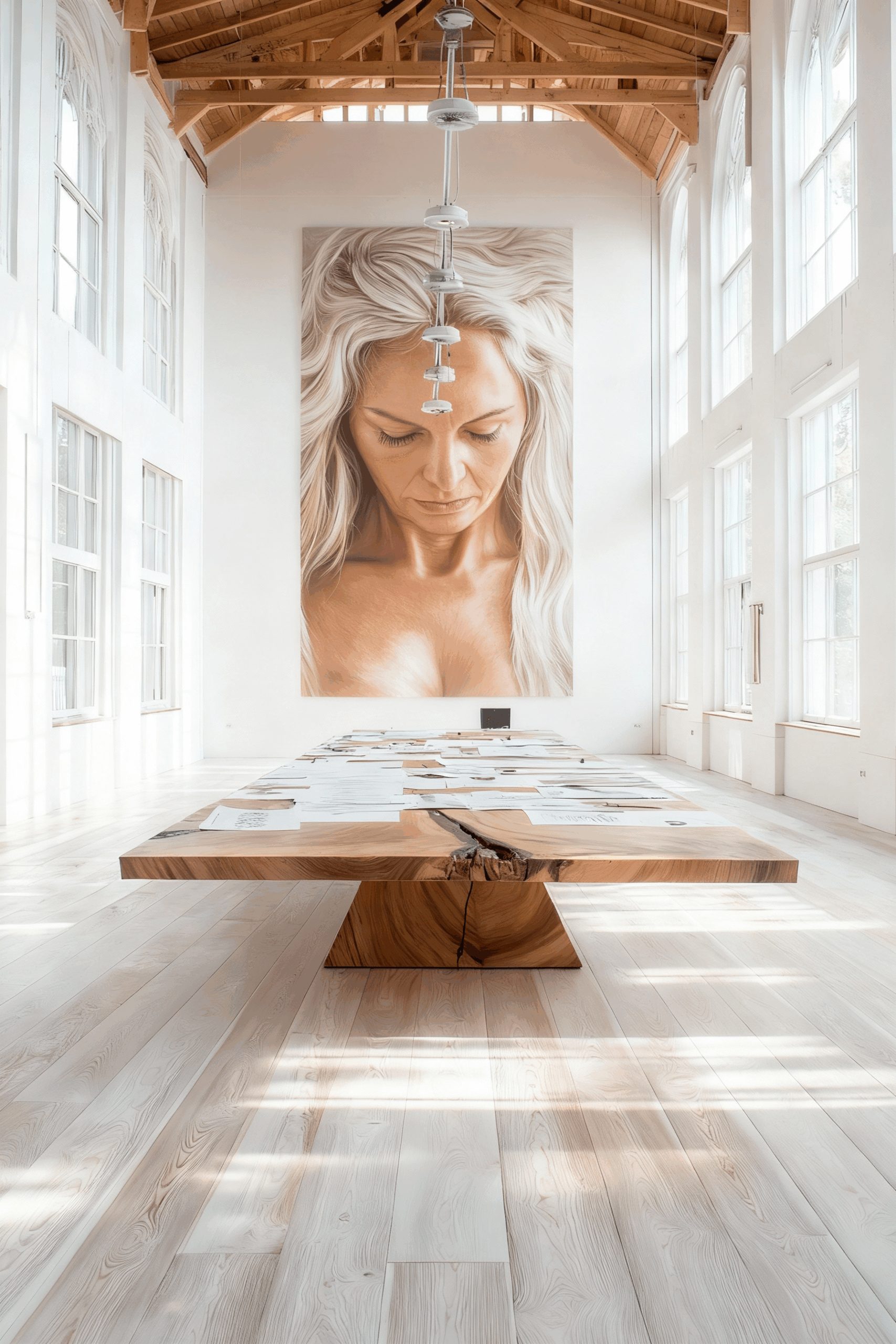
The film wastes no time establishing its thesis: creativity is a secular religion, and this space is its church. We are not in a sterile office, but in a converted cathedral. Sunlight streams through towering windows not as mere illumination, but as a divine presence. The camera’s initial wide shot frames a team gathered like acolytes around a massive wooden altar—their conference table.
This is where the film proves its intelligence. It doesn’t rush to show us the art. It shows us the act of looking at the art. The camera dollies in with reverence, not on faces, but on the details of creation: a finger tracing a crop line on a photograph, eyes scanning a layout, the dust motes floating in sunbeams like incense. The team’s movements are fluid, a silent ballet of consideration. The space, with its sacred bones, blesses the mundane: a promo sheet, a contact sheet, a gesture. It declares that what happens here is important.
Act II: The Alchemy of Artificial Light
As the sun arcs, the film performs its quiet magic. The camera becomes a fixed observer, a witness to the passage of a creative day. The crisp, honest daylight softens, then surrenders to the warm, intentional glow of the hanging lamps. The space transforms. The cathedral becomes a cocoon.
Now, the work intensifies. Four professionals circle the table in the dying light. Their discussion, though unheard, is written in their posture—the lean-ins, the lifted prints held against the lamplight. The film’s most powerful character emerges: shadow. Their movements cast long, dramatic silhouettes that stretch across the wooden surface, a visual echo of their intellectual reach. This is the charette’s peak—the focused, time-bound push where ideas are forged and decisions are made.
Act III: The Animating Spark & The Aftermath
Then, the humans exit. They leave the darkening room, their wake causing documents to flutter like settling leaves. The film could end on this beautiful, empty tableau. But THE CHARETTE has one final, brilliant revelation.
In the perfect stillness, a portrait on the wall—a subject previously inanimate—subtles. An eye opens. A knowing smile and a wink are offered to the empty room. Then, it closes as night fully claims the space.
This moment is the film’s entire argument. It is the magic that the charette seeks to capture. The team’s labor, their debate in the dust and light, is all in service of creating that spark of life—the wink, the connection, the soul in the still image. The portrait’s animation is the ghost in the machine, the proof that their secular communion worked. The art is no longer just paper on a table. It lives.