Most architecture films worship the empty building. They fetishize sterile perfection. The short film “Violet Vibrancy” presents a counterargument. It posits that space is only a vessel, and its true purpose is revealed in the collision between designed environment and human spontaneity. This is its clever, two-act structure.
Act I: The Reverse Engineering of Atmosphere
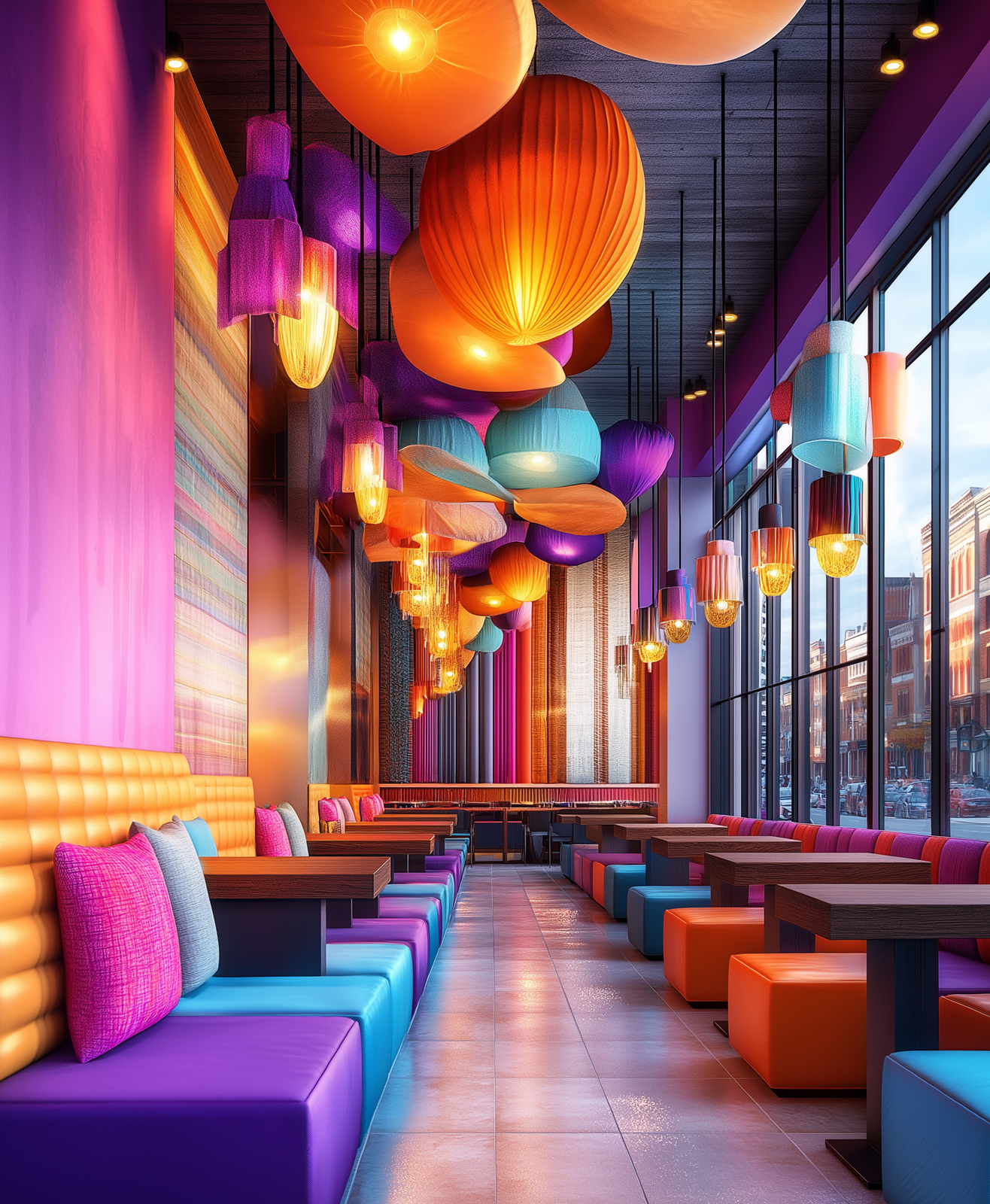
The film opens with a subversive trick. It begins in what most would consider the climax: a vibrant restaurant interior bathed in golden hour sun. Benches glow in blue and purple. Long, dramatic shadows paint the walls. Then, the camera holds. It remains absolutely stationary, refusing to tour. Instead, it makes us watch the director’s masterstroke: time runs backward.
We don’t move from day to night. We rewind from warm, natural perfection into constructed ambiance. The sunlight doesn’t fade; it intensifies, retracting its golden tendrils. The pendant lights don’t turn on; they turn off, their warm glow snuffing out one by one with a satisfying click-hum. The hidden coves of cerulean and magenta light swallow their colors back into the walls.
Outside, the inky indigo night sky bleaches backward through violet into daylight. The film strips away the artificial energy, layer by meticulous layer, to reveal the quieter, sun-drenched skeleton of the space. It’s a deconstruction. A reveal of the architectural machinery behind nocturnal vibe. Act I ends not with a building coming to life, but with it being put to sleep. The stage is reset, pristine and waiting.
Act II: The Human Ignition
This is where lesser films would end. “Violet Vibrancy” is just getting started.
From this state of quiet, sunlit readiness, the camera finally moves. A dynamic glide through the now-colorful space, past purple and orange furniture, under a kaleidoscope of hanging lanterns. The palette is no longer passive; it is a loaded canvas.
And then, the payoff. The thesis.
A burst of kinetic energy fractures the calm. Five school-aged friends explode into the frame, a comet tail of laughter and motion blur. They are not extras. They are the final, essential design element. Notice the deliberate casting: a spectrum of identities as vibrant and intentional as the lanterns above. The girl with sunflower-yellow hoodie, the graphic cat t-shirt, the colorful beads in braids—they are individual brushstrokes in a painting of collective joy.
They don’t just enter the space; they complete the circuit that Act One so carefully wired. The artificial light built a potential for energy. These girls are the current. They are the “vibrancy” promised in the title.
The Vision, Realized
“Violet Vibrancy” is a witty, precise equation. Act One (The Reverse Transition) + Act Two (The Human Injection) = a complete story of place.
It argues that the magic of a space isn’t in its empty perfection at golden hour. The real magic is in its engineered ability to hold the golden hour of human connection, long after the sun has set. The film doesn’t just show a pretty restaurant. It demonstrates, with flawless cinematic logic, that the best architecture is not a monument, but a catalyst. The lights, the colors, the shadows—they are all just prelude. The people are the point.